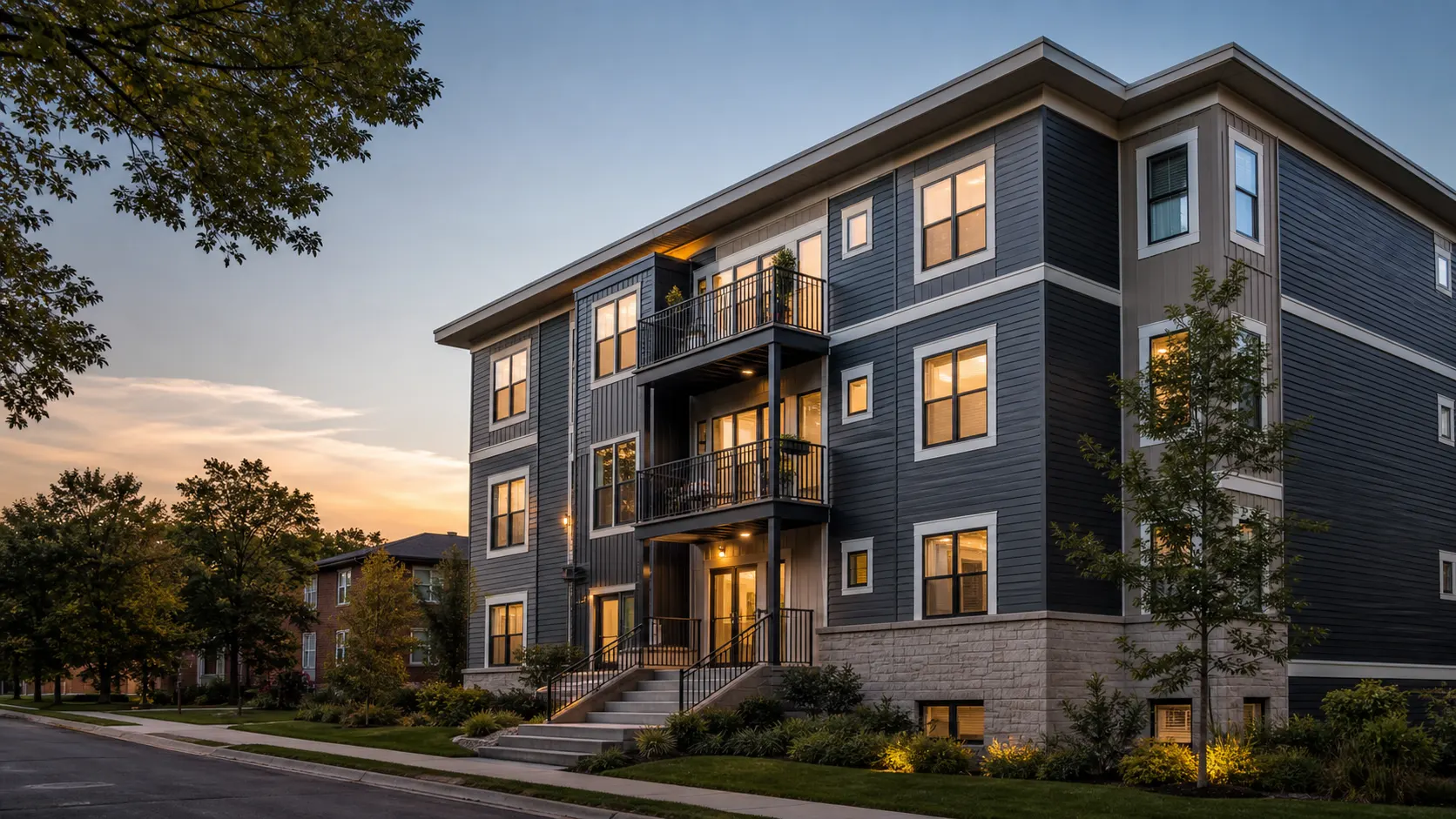
Kansas City multifamily siding

Multifamily siding replacement for Kansas City apartments, condos, and HOAs

Siding replacement for Kansas City apartments, condos, townhomes, and HOA communities — with hail-resistant materials, bid scope, and funding help.

Get a siding replacement review

We help boards, property managers, and apartment owners across the Kansas City metro replace siding the right way — choosing a material that holds up to KC hail, getting a bid scope you can actually compare, and lining up the funding — then connect you with a local crew that does occupied-building work correctly.

Why multifamily siding is a bigger project than siding a house.

Re-siding a single home is mostly a product-and-color decision. Re-siding an apartment, condo, or townhome community is three decisions at once, and they’re harder: which material survives Kansas City hail, how the work gets done while residents stay in their units, and how the association or owner pays for a six-figure project that reserves often don’t fully cover. On top of that, the bid has to be detailed enough that several contractors can be compared fairly. This site is built to help you work through all three before you commit to anything.

The four things that decide a multifamily siding project.

A low bid isn’t a good bid if it leaves out tear-off, hidden rot repair, the water-resistive barrier, flashing, trim, disposal, access equipment, or resident notices. Defining the full scope is what makes competing bids comparable. Four areas drive the outcome:

Material and hail resistance. Kansas City sits in one of the country’s most active hail corridors, so the siding material — and the wall details behind it — are a durability decision first. The right choice lowers the odds of another insurance claim after the next storm.

Occupied-building logistics. Residents stay in their units throughout. A real plan sequences the work building-by-building and elevation-by-elevation and handles parking, balconies, entrances, and advance notices, so the schedule holds and residents know what to expect.

A comparable bid scope. Boards and owners need quotes that line up item for item: material, tear-off, sheathing and rot repair, housewrap, flashing, trim, disposal, access, warranty, and clearly separated options for phased work.

Funding. Most associations cover a project this size with a mix of reserves, a special assessment, and a loan. Because Missouri and Kansas don’t require associations to fund reserves, the funding plan is usually the hardest part — so it’s worth mapping before bids go out.

The wall system behind the siding.

What goes behind the panel matters as much as the panel itself: the water-resistive barrier, flashing at every window and door, kick-out flashing where roofs meet walls, sound trim transitions, and the damaged sheathing that almost always turns up once the old siding comes off. Kansas City’s worst siding failures — old hardboard and stucco — were water getting in behind the cladding, not the cladding wearing out. Re-siding without correcting those details just repeats the problem. In Kansas City, MO a multifamily re-side requires a permit, and on the Kansas side, Johnson County requires a licensed contractor.

Who we help: boards, managers, and owners.

For HOA, condo & townhome boards — You’re a volunteer making a major decision your neighbors will judge. Get a fundable plan, a bid comparison you can defend, and a clear read on how associations here pay for siding.

For community association managers — You run projects for boards across a portfolio, often several after the same storm. Get a partner who documents everything board-ready, handles resident logistics, and doesn’t create callbacks.

For apartment owners & operators — You’re protecting NOI, working a hail claim, or getting ahead of a sale or refinance. Get per-unit cost framing, hail-durable material guidance that lowers future claims, and minimal-vacancy execution.

Siding in Kansas City: hail, aging buildings, and code.

Hail is the dominant threat. Missouri had a 182% increase in major hail events from 2022 to 2024 — the largest jump of any U.S. state — and radar has detected hail at or near Kansas City on 193 separate occasions. For a building with a lot of exterior surface, hail is the most common and most expensive damage event, which is why impact resistance leads the material decision. (NOAA data via Insurify; Interactive Hail Maps.)

Aging 1980s–90s siding. A large share of KC’s apartment and townhome stock dates to the 1980s and 90s — the same era as Masonite and LP hardboard composite siding, which led to some of the largest class actions in siding history for swelling and rot. If your building has that board, knowing it changes the plan. (In re Masonite Corp.; LP Inner-Seal settlement.)

The right James Hardie spec for KC. Kansas City falls in James Hardie’s HZ5 climate zone — the cold-weather, freeze-thaw product line — not the Southern HZ10 line. It’s a spec detail a lot of out-of-town content gets wrong, and it matters for how fiber cement performs here. (James Hardie HardieZone system.)

Which siding holds up best to Kansas City hail?

For KC multifamily, the practical options are engineered wood (LP SmartSide), steel, fiber cement (James Hardie HZ5), and vinyl, with stucco/EIFS usually a replace-with-care case. Because hail leads here, impact resistance comes first: LP SmartSide is warranted against hail up to 1.75 inches and steel carries the highest impact ratings.

MaterialHail / impactLifespanBest KC multifamily fit
Engineered wood (LP SmartSide)Strong — warranted to 1.75″ hail40–50 yrValue + hail/cold balance; eases big reclads
SteelExcellent — most panels UL 2218 Class 450+ yrMost hail-resistant; low-maintenance
Fiber cement (James Hardie HZ5)Moderate — can crack above ~1.5″ hail50+ yrFire-rated, premium finish
VinylWeak — brittle in deep cold & hail20–30 yrBudget / value housing

Full five-material breakdown, including stucco/EIFS: best siding for Kansas City hail.

Who does the installation.

The work is handled by a Kansas City exterior crew that does occupied-building siding replacement — a BBB A+ accredited, 5.0-rated team led by a contractor who spent 15+ years at the James Hardie National Office training installers on correct installation and warranty compliance, and whose company won Hardie’s 2023 Contractor Alliance Service Excellence Award. Those install details decide how long a re-side lasts, which is why this site leads with them.

Service area: the Kansas City metro, both states.

Kansas: Overland Park · Olathe · Lenexa · Shawnee · Leawood · Prairie Village · Kansas City, KS Missouri: Kansas City, MO · Lee’s Summit · Blue Springs · Independence · Liberty · Gladstone · North Kansas City

FAQ

Q: How do associations in Kansas City usually pay for siding replacement? Most use some mix of replacement reserves, a special assessment, and an association loan. Because neither Missouri nor Kansas requires associations to fund reserves, many KC communities reach the siding bill before the savings are there — so the funding plan is part of the project. The strongest plans use whatever reserves exist and structure an assessment owners can absorb.

Q: What’s the best siding for Kansas City’s hail? Impact resistance leads here. LP SmartSide engineered wood is warranted against hail up to 1.75 inches and steel carries the highest impact ratings; James Hardie fiber cement (HZ5 spec for KC) is the fire-rated premium option; vinyl is the budget choice that gets brittle in deep cold. The right pick depends on budget, building type, and fire/code needs.

Q: Can residents stay in their units during the work? Yes. Occupied-building siding replacement is the normal case for multifamily. The crew sequences the work building-by-building and elevation-by-elevation, and a communication plan handles parking, access, and noise. Relocation usually isn’t needed.

Q: Do you need a permit to re-side a multifamily building in KC? Yes. In Kansas City, MO the exemption for replacing exterior wall covering applies only to detached one- and two-family homes, so apartments, condos, and townhome buildings need a permit. On the Kansas side, Johnson County requires a licensed contractor for permitted work.

Q: Is this a contractor or a resource? Both. The site helps owners, boards, and managers get the scope and funding right before they request bids, and it connects you with a Kansas City crew that does the installation. It doesn’t publish credentials it can’t back up.

Get a siding replacement review.

Tell us about the building and what’s going on with the siding, and we’ll help you turn it into a bid-ready scope — the hail and moisture risks to check, the funding paths to weigh, and the questions to put in front of every contractor.